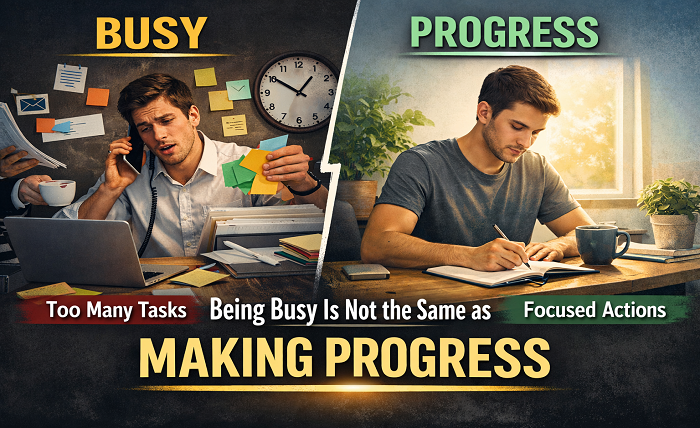
A packed day can feel productive even when it leaves nothing meaningful behind. You answer messages, attend meetings, run errands, cross off tiny tasks, and collapse at night with the strange comfort of having been busy. But then the next morning arrives, and the important work is still waiting.
That is the trap. Busyness creates motion, noise, and visible effort. Progress creates movement toward a goal. The two can overlap, but they are not the same thing. In money matters, people can fall into the same pattern by constantly rearranging small expenses while avoiding the bigger issue, which is why real progress sometimes includes practical steps such as credit card debt relief rather than another week of frantic tinkering.
Busyness often feels safer because it is easier to perform. Progress is quieter. It asks you to choose, to prioritize, and sometimes to disappoint people by not being available for everything.
Busyness often protects us from harder decisions
One reason people stay busy is that busyness can hide uncertainty. If you are moving all the time, you do not have to sit still long enough to ask whether your effort is aimed at the right target.
That is uncomfortable, because real progress usually requires subtraction. You cannot focus on the work that matters most while treating every request, notification, and idea as equally urgent. At some point, progress asks what deserves your energy and what merely consumes it.
This is true in personal life and at work. A full calendar may impress people, but it does not automatically build anything worthwhile. In fact, many teams are starting to recognize the difference between output and activity, which is why conversations about productivity versus busyness have become more common.
The loudest work is not always the most important work
Busyness usually favors the visible. Fast replies. Quick tasks. Constant availability. These behaviors can create the impression of value because they are easy to observe. But many meaningful outcomes require deeper concentration and longer timelines. Writing, planning, problem solving, learning, recovery, and relationship building all suffer when your day is chopped into tiny fragments.
This creates a strange problem. The work that produces the most value is often the work least rewarded by a culture obsessed with speed and responsiveness.
That does not mean small tasks do not matter. They do. It means they should not be allowed to consume the space meant for your actual priorities.
There is a reason workplace thinkers keep warning about a culture of busyness. When activity itself becomes the status marker, people start optimizing for appearance instead of impact.
Progress starts with a better daily question
If you want to break the busyness habit, stop asking, “What do I need to get done today?” and start asking, “What would actually move something forward today?”
Those questions sound similar, but they produce different behavior. The first encourages accumulation. The second demands selection.
Maybe the thing that advances your goal is not answering twelve emails before breakfast. Maybe it is making one difficult phone call. Maybe it is reviewing your budget honestly. Maybe it is blocking ninety quiet minutes for a project that has been sitting untouched for weeks. Maybe it is resting so you can think clearly again.
Progress is often built through fewer, better actions.
Being overwhelmed does not prove you are effective
This is a hard idea for many people because stress can become part of identity. If you are always stretched thin, it can feel like evidence that your life is important. But feeling overloaded is not the same as creating value.
Sometimes it means the opposite. It may signal weak boundaries, unclear priorities, poor systems, or a habit of saying yes too quickly. The fix is not necessarily more effort. It may be better design.
That can include simpler routines, fewer commitments, better planning windows, protected focus time, and regular review of what is worth continuing.
Quiet effectiveness rarely gets applause in the moment
There is something almost invisible about genuine progress. It may not create dramatic stories. It may look like saying no to low value meetings, repeating a boring savings transfer, writing one thoughtful page a day, or doing the same maintenance habit for six months in a row.
None of that is glamorous. All of it works.
This is why busyness is so tempting. It creates a more immediate emotional payoff. You feel engaged. Needed. In motion. Progress asks for patience. It often feels slower even when it is more effective.
The real shift is from reaction to intention
At its core, the difference between busyness and progress is the difference between reacting and directing. Busyness lets the day happen to you. Progress asks you to shape the day around what matters.
That does not mean every day will feel clean and focused. Life is messy. Some seasons genuinely require more logistics than others. But even then, a small amount of intention changes everything. One protected hour. One meaningful task completed before the noise begins. One honest check on whether your effort still matches your goals.
If your days feel full but strangely empty, that may be the signal. You do not necessarily need more discipline, energy, or hustle. You may simply need to stop confusing movement with advancement.
Busy can feel productive. Progress is what actually changes your life.